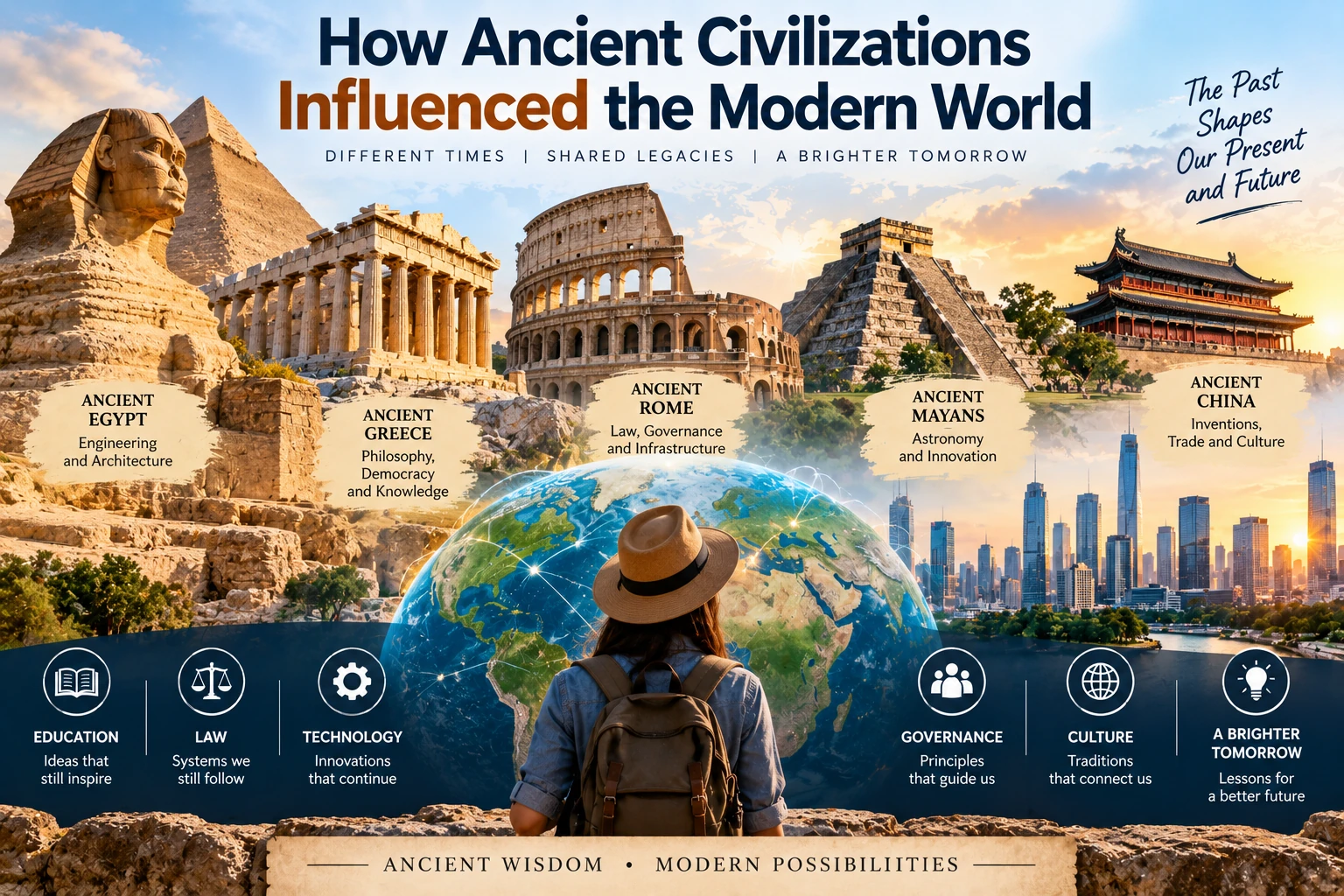
The modern world is built on centuries of human discovery, experimentation, organization, and cultural development. Long before modern technology and industrial societies emerged, ancient civilizations developed systems that shaped the way people lived, governed communities, built cities, conducted trade, recorded information, and understood the world. From writing and mathematics to architecture and government, many ideas developed thousands of years ago continue to influence modern society.
The Development of Writing
One of the most significant achievements of ancient civilizations was the development of writing systems. Early writing allowed societies to record laws, trade transactions, religious practices, historical events, and administrative information.
Writing made it possible to preserve knowledge across generations rather than relying entirely on oral traditions. Modern governments, businesses, schools, and legal systems continue to depend on written communication, making the early development of writing a fundamental milestone in human history.
Contributions to Mathematics
Ancient societies made important advances in mathematics to solve practical problems involving construction, agriculture, trade, taxation, and astronomy.
Mathematical knowledge developed by civilizations in regions such as Mesopotamia, Egypt, India, China, Greece, and the Islamic world contributed to concepts that later became important to science, engineering, commerce, and education. Numbers, measurement systems, geometry, and mathematical methods remain essential to modern life.
Influence on Government and Law
Ancient civilizations developed different approaches to organizing societies and establishing rules. Written laws provided frameworks for addressing property, trade, personal disputes, and social responsibilities.
Ancient political thinkers also explored ideas about citizenship, leadership, justice, and government. Although modern political systems are considerably different, some concepts discussed in ancient societies continue to influence political philosophy and civic institutions.
Architectural Achievements
Ancient builders demonstrated remarkable abilities in engineering and construction. Pyramids, temples, roads, aqueducts, theaters, bridges, and other structures show how civilizations developed methods for working with materials and organizing large construction projects.
Ancient architectural principles continue to influence modern design. Columns, arches, symmetry, public squares, and monumental structures can still be seen in contemporary government buildings, museums, universities, and other public spaces.
Advances in Science and Astronomy
Ancient civilizations closely observed the natural world. People studied the movement of the sun, moon, planets, and stars to create calendars, plan agricultural activities, navigate, and understand seasonal changes.
Astronomical observations made by ancient scholars contributed to the development of later scientific traditions. Their attempts to explain natural phenomena also helped establish methods of observation and measurement that became increasingly important to scientific inquiry.
Medicine and Health Practices
Ancient societies developed various medical practices based on observation, experience, and traditional knowledge. Egyptian, Greek, Indian, Chinese, and other medical traditions recorded information about illnesses, treatments, anatomy, herbs, and hygiene.
While many ancient medical beliefs have since been replaced or revised, historical medical knowledge contributed to the gradual development of organized approaches to healthcare and medical study.
Philosophy and Critical Thinking
Ancient philosophers explored questions about morality, knowledge, politics, society, logic, and human behavior. Their writings encouraged people to question assumptions and use reasoning to examine complex ideas.
Philosophical traditions from ancient Greece, India, China, and other regions continue to influence modern education, ethics, political theory, and academic thought.
Trade and Cultural Exchange
Ancient civilizations established extensive trade networks connecting distant regions. Merchants exchanged goods such as spices, metals, textiles, ceramics, food products, and precious materials.
Trade routes also enabled the movement of languages, technologies, religious ideas, artistic styles, and scientific knowledge. These exchanges helped different societies influence one another and contributed to the development of interconnected cultures.
Agriculture and Urban Development
Ancient communities developed agricultural techniques that supported larger populations. Irrigation systems, crop management, animal domestication, and food storage helped societies become more stable and establish permanent settlements.
As populations grew, cities emerged as centers of trade, administration, culture, and learning. Modern urban life has developed in vastly different circumstances, but the basic idea of cities serving as economic and social hubs has ancient roots.
Preserving Knowledge for Future Generations
Ancient libraries, schools, inscriptions, manuscripts, and monuments helped preserve human knowledge. Although many records were lost through wars, disasters, and the passage of time, surviving sources provide valuable information about earlier societies.
The preservation of historical knowledge continues to be important today. Libraries, museums, universities, archives, and digital databases serve a similar purpose by protecting information for future generations.
Conclusion
Ancient civilizations played a foundational role in shaping the modern world. Their contributions to writing, mathematics, government, architecture, science, medicine, philosophy, agriculture, and trade created ideas and systems that influenced later societies. Modern technology and institutions may look very different from those of the ancient world, but many of today’s achievements are connected to centuries of accumulated knowledge. Studying ancient civilizations therefore helps us understand not only the past but also the foundations of modern life.