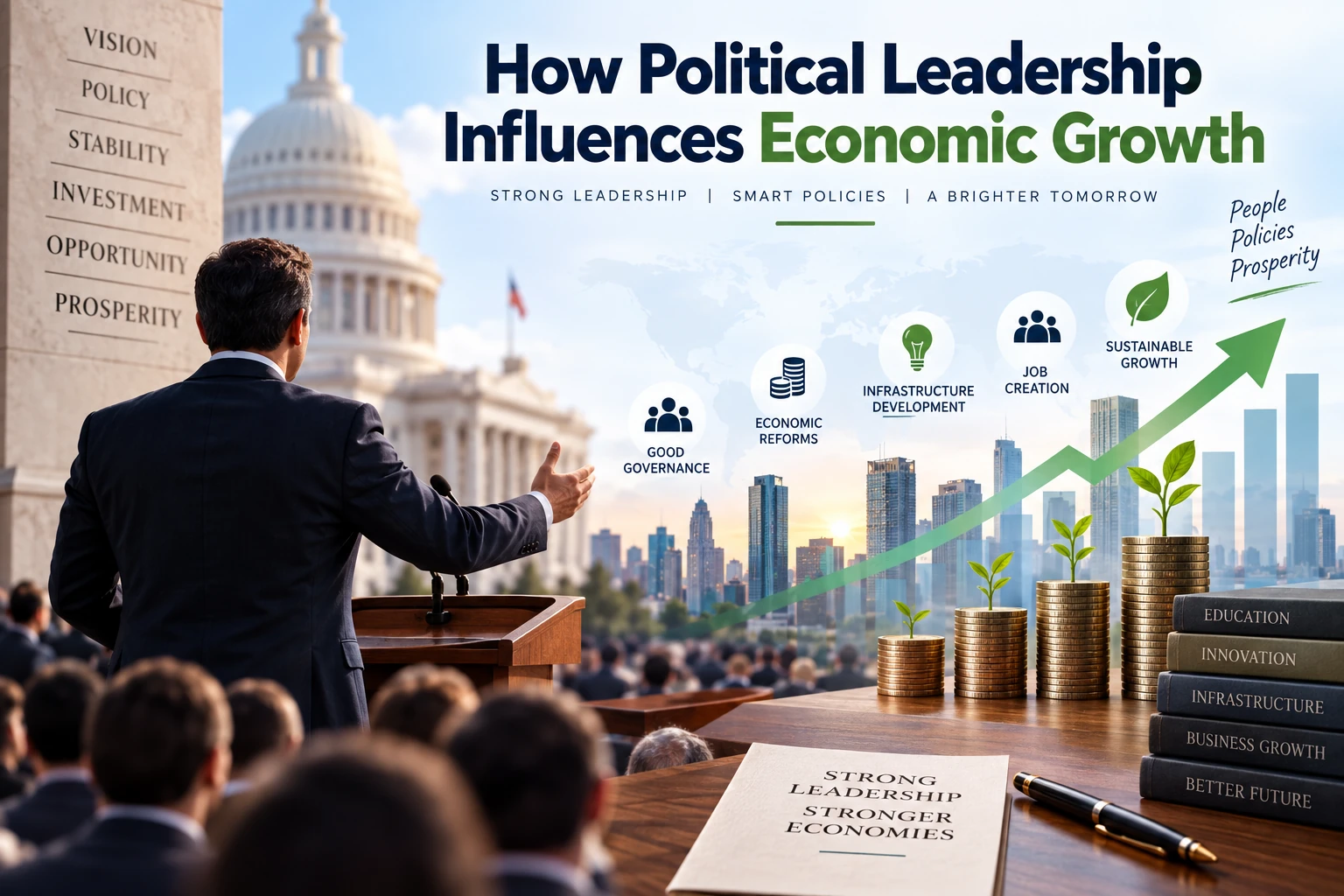
Political leadership plays an important role in shaping a country’s economic direction. Governments make decisions about taxation, public spending, infrastructure, education, trade, business regulations, and investment. These choices can influence how confidently businesses invest, how effectively resources are used, and how many opportunities are available to citizens.
Economic growth does not depend on political leaders alone. Private businesses, workers, consumers, technological developments, international conditions, natural resources, and global markets all contribute. However, effective political leadership can create an environment in which these economic forces can operate more productively.
Creating Economic Stability
Businesses generally make investment decisions with the future in mind. When political institutions provide predictable policies and consistent rules, businesses may feel more confident about making long-term investments.
Frequent and unexpected policy changes can create uncertainty. Companies may delay expansion, hiring, or investment when they cannot clearly anticipate future regulations or economic conditions. Strong leadership can therefore contribute to stability by communicating policies clearly and supporting reliable institutions.
Investing in Infrastructure
Infrastructure is a major foundation of economic activity. Roads, railways, ports, airports, electricity networks, water systems, and digital connectivity help businesses move goods, provide services, and reach customers.
Political leaders influence infrastructure development through government budgets, planning, regulation, and partnerships with private organizations. Well-planned infrastructure can reduce transportation and operating costs while connecting smaller communities to larger markets.
Supporting Education and Skills
A country’s workforce is one of its most important economic resources. Education and vocational training can help people develop skills required by changing industries.
Political leadership influences education through public investment, curriculum policies, vocational programs, higher education funding, and initiatives designed to improve access to learning. A skilled workforce can improve productivity and help businesses adopt new technologies and compete in international markets.
Encouraging Business and Entrepreneurship
Small businesses and entrepreneurs can contribute significantly to employment, innovation, and local economic development. Government policies can either encourage or discourage entrepreneurial activity.
Simple registration procedures, transparent regulations, access to infrastructure, and predictable taxation can make it easier for businesses to operate. Leaders can also support entrepreneurship through training programs, financing initiatives, innovation policies, and institutions that protect legitimate business activity.
Maintaining Responsible Economic Policies
Government spending and taxation can have significant effects on economic activity. Public spending can support infrastructure and essential services, while taxation provides revenue for government programs.
Responsible leadership requires balancing immediate economic needs with long-term financial sustainability. Excessive spending without adequate planning can create fiscal pressures, while insufficient investment can limit development. Effective policymaking attempts to use public resources efficiently while maintaining confidence in the broader economy.
Promoting Trade and Investment
International trade can provide businesses with access to larger markets, new technologies, raw materials, and investment opportunities. Political leaders influence trade through agreements, tariffs, customs policies, diplomatic relationships, and investment regulations.
A country that develops constructive international economic relationships may create additional opportunities for domestic industries. At the same time, leaders must consider the interests of local workers, businesses, and consumers when designing trade policies.
Strengthening Institutions and Governance
Economic growth depends not only on individual policies but also on the quality of institutions. Transparent public administration, predictable laws, effective courts, and responsible regulatory systems can create greater confidence among businesses and citizens.
When institutions function effectively, contracts can be enforced, property rights can be protected, and economic rules can be applied more consistently. Strong institutions can therefore support investment and productivity over the long term.
Responding to Economic Challenges
Political leadership is particularly important during economic difficulties. Recessions, inflation, financial disruptions, natural disasters, and global crises can create pressure on businesses and households.
Governments may respond through targeted financial measures, employment programs, infrastructure spending, regulatory adjustments, or support for affected industries. The quality and timing of such responses can influence how quickly an economy recovers.
Balancing Growth With Inclusion
Economic growth is most meaningful when its benefits reach a broad section of society. Political leaders must consider employment opportunities, access to education, healthcare, infrastructure, and economic participation.
Policies that encourage growth while also addressing inequality and regional differences can help create a more inclusive economy. Sustainable development requires attention not only to how much an economy grows but also to how that growth improves people’s opportunities and living standards.
Conclusion
Political leadership can strongly influence economic growth through decisions involving infrastructure, education, taxation, regulation, trade, investment, and public spending. Effective leaders can help create stable institutions and an environment that encourages innovation, entrepreneurship, and productive investment. At the same time, economic outcomes depend on many factors beyond government control. The strongest approach is therefore one that combines sound leadership with strong institutions, skilled workers, responsible businesses, and long-term economic planning.